Metal Products
Custom Multi-Color Enamel Pins: From Artwork to Finished Badges
Learn how custom multi-color enamel pins are made, from artwork and metal plating to enamel filling, quality checks and bulk ordering.
Custom Multi-Color Enamel Pins: From Artwork to Finished Badges
Custom enamel pins are widely used for promotional merchandise, souvenir collections, corporate branding, clubs, festivals, and special events.
With colorful artwork, detailed metal outlines, and custom shapes, a small enamel pin can transform a logo or illustration into a distinctive physical product.
However, manufacturing a colorful metal badge involves more than simply printing an image onto metal. The design must be adapted for tooling, color separation, metal finishing, enamel filling, and final assembly.
In this guide, we explain how custom multi-color enamel pins are designed and manufactured, using a colorful cartoon-style metal badge as a practical example.
We also discuss the differences between soft and hard enamel, common production considerations, and what international B2B buyers should prepare before requesting a bulk quotation.
1. What Are Multi-Color Enamel Pins?
Multi-color enamel pins are custom metal accessories that combine a shaped metal base with colored decorative areas.
Depending on the manufacturing method, the colored areas may be filled with enamel-type coatings or other suitable materials.
Raised metal lines often separate different colors, creating clear boundaries between parts of the design.
These pins are commonly used for:
- Corporate promotional merchandise
- Festival and event souvenirs
- Clubs and associations
- Tourist gift shops
- Brand merchandise collections
- School and university events
- Employee recognition programs
- Collectible character accessories
For buyers developing branded products, enamel pins offer opportunities to combine custom artwork, distinctive shapes, and different metal finishes.
2. A Colorful Custom Metal Badge Design Example
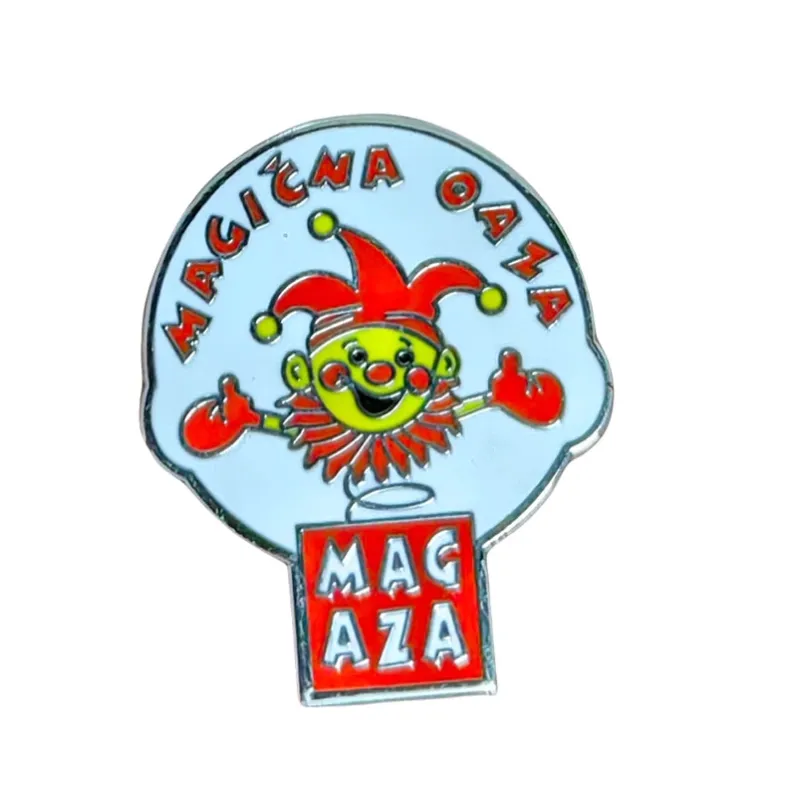
The metal badge shown in our featured product photograph uses several decorative elements to create a distinctive appearance.
The design includes:
- A light blue background
- A colorful cartoon-style clown illustration
- Red, yellow, and green decorative details
- Raised metallic outlines
- Custom lettering
- An irregular outer shape
- A rectangular extension at the bottom
One interesting feature is how the metal outlines help visually separate the different colored areas.
Instead of relying on printed color transitions, the design uses defined shapes and contrasting colors to make the central illustration recognizable.
The bottom extension also shows how a custom badge does not have to follow a conventional round or rectangular shape.
For businesses developing event souvenirs or promotional pins, this is a useful example of how custom artwork can be adapted into a shaped metal product.
3. How Are Custom Enamel Pins Manufactured?
The production process depends on the selected material, finish, enamel method, and design complexity.
A typical custom enamel pin manufacturing project may involve the following stages.
Step 1: Artwork Review and Design Preparation
Manufacturing begins with the customer's logo, illustration, or badge design.
The artwork must be reviewed to determine whether it can be reproduced accurately in metal.
Important factors include:
- Overall pin dimensions
- Shape and outline
- Minimum line thickness
- Spacing between colors
- Text size and readability
- Metal border requirements
- Enamel filling areas
Very small lettering or extremely thin lines may require adjustments.
For detailed cartoon-style badges, maintaining clear boundaries between different colors is particularly important.
Step 2: Mold and Tooling Preparation
Custom designs commonly require dedicated tooling to create the required metal shape and surface details.
Depending on the production method, the supplier may use stamping, die-striking, casting, or other suitable metal-forming techniques.
Tooling selection depends on the product structure, metal material, required detail, and quantity.
Buyers should confirm whether a new mold is necessary and whether any tooling charges are included in the quotation.
Step 3: Creating the Metal Base
After tooling is prepared, the metal base is formed according to the approved design.
The base includes the overall shape and the metal structures needed to separate decorative areas.
Depending on the design, additional finishing or edge treatment may be required.
The metal base must be sufficiently accurate to support the later color-filling process.
Step 4: Metal Plating and Surface Finishing
Metal plating affects the appearance of the finished badge.
Common finishes may include:
- Bright gold
- Bright silver
- Nickel
- Antique gold
- Antique silver
- Black nickel
- Other available finishes
The plating process and sequence vary depending on the selected manufacturing method.
For example, bright silver-colored plating can create a contrasting outline around colorful enamel areas.
Antique finishes may be preferred for vintage-style souvenirs or commemorative designs.
Step 5: Enamel Color Filling
Color filling is one of the most recognizable stages of enamel pin manufacturing.
Suitable colored material is applied to the designated areas of the metal base.
For multi-color designs, different sections must be filled carefully to achieve the intended appearance.
The specific materials, curing procedures, and finishing steps depend on whether the selected product uses soft enamel, hard enamel, or another decorative system.
Step 6: Finishing and Quality Inspection
After the required color and finishing operations, the badges are inspected.
Typical inspection points include:
- Overall shape
- Correct dimensions
- Color placement
- Surface appearance
- Metal finish consistency
- Lettering clarity
- Visible defects
- Backing attachment quality
The finished badges are then assembled with the selected attachments and prepared for packaging.
4. Soft Enamel vs Hard Enamel Pins
One of the most important decisions when ordering custom enamel pins is selecting the enamel style.
Soft Enamel Pins
Soft enamel pins typically have recessed colored areas separated by raised metal borders.
The difference in surface height creates a textured appearance.
This method is often suitable for designs that benefit from defined metal outlines and visible dimensional detail.
Hard Enamel Pins
Hard enamel pins generally have a smoother, more level finished surface after the required filling and polishing processes.
The production process may involve additional finishing steps to achieve the desired surface appearance.
Which Should You Choose?
Feature | Soft Enamel | Hard Enamel |
|---|---|---|
Surface | Typically recessed color areas | Typically smooth and level |
Metal outlines | Raised and prominent | Integrated into a smoother finish |
Visual appearance | Textured | Polished |
Relative production cost | Often lower | Often higher |
Suitable applications | Promotional pins and event badges | Premium-looking branded and collectible pins |
The best choice depends on the design, desired finish, budget, and product requirements.
The appearance of a photograph alone is not always enough to identify the manufacturing method accurately.
Ask the supplier to confirm the actual enamel process before ordering.
5. Designing Multi-Color Enamel Pins
An attractive illustration does not always translate directly into an effective enamel pin.
Certain design adjustments may improve manufacturability and appearance.
Keep Color Areas Clearly Defined
Each enamel section should be sufficiently large for the selected filling method.
Very small or tightly spaced areas may be difficult to fill consistently.
Use Suitable Metal Borders
Metal outlines can separate colors and define important graphic details.
The required border width depends on the manufacturing method and tooling limitations.
Maintain Readable Lettering
Small text can become difficult to recognize after an illustration is reduced to pin size.
For promotional badges with names or slogans, review the actual finished dimensions before approving the artwork.
Choose Colors Carefully
Pantone references can help communicate desired colors.
However, the final enamel appearance may differ from digital artwork because of materials, lighting, and manufacturing conditions.
Consider the Overall Shape
A custom outline can make a badge more memorable, but narrow projections and delicate extensions may require additional design review.
The product should also have sufficient structure around the backing attachment.
6. What Metal Materials Are Used for Enamel Pins?
Common metal base materials can include iron, zinc alloy, brass, and other suitable metals.
The selected material depends on factors such as:
- Product shape
- Design complexity
- Required thickness
- Desired weight
- Manufacturing method
- Surface finish
- Order quantity
For example, some irregular or dimensional designs may be suitable for zinc alloy manufacturing, while other designs may use stamped or die-struck metal bases.
There is no single material that is best for every custom pin project.
Buyers should confirm the material and production process based on their actual artwork and intended use.
7. How to Choose the Right Pin Backing
The front design determines how the pin looks, but the backing affects how it is worn or attached.
Common options include:
Butterfly Clutch: A compact metal fastening system frequently used for promotional lapel pins.
Rubber Clutch: A flexible backing option that may be available in different colors.
Safety Pin Back: A possible choice for certain larger badge styles.
Magnetic Back: An alternative for suitable designs where piercing the fabric is undesirable.
For larger or irregularly shaped badges, two pin posts may help improve stability and reduce rotation.
The correct attachment should be selected according to the badge's size, weight, shape, and intended application.
8. What Affects the Cost of Custom Enamel Pins?
Wholesale enamel pin pricing depends on several factors.
Product Size
Larger badges generally use more material and may require more finishing work.
Design Complexity
Intricate shapes, detailed lettering, and complicated color areas can increase tooling and production requirements.
Number of Enamel Colors
More colors may require additional filling operations and quality checks.
Enamel Type
Soft enamel and hard enamel can have different manufacturing and finishing costs.
Metal Material and Plating
Different base materials and plating finishes may affect the quotation.
Order Quantity
Larger quantities can distribute fixed tooling and setup costs across more units.
Attachments and Packaging
Special backing systems, backing cards, individual bags, and customized gift boxes may increase the total cost.
For accurate comparisons, buyers should request quotations based on the same specifications.
9. What Is the MOQ for Custom Enamel Pins?
MOQ stands for Minimum Order Quantity.
The minimum quantity for custom metal badges varies according to the supplier, tooling, production method, and design requirements.
There is no universal MOQ for every enamel pin project.
If you require a small batch, ask whether low-quantity custom production is available.
For larger orders, consider requesting prices at several quantity levels, such as 100, 300, 500, and 1,000 pieces.
These are example quotation quantities, not guaranteed minimum order levels.
10. Why Is Sample Approval Important?
For colorful and detailed metal badges, sample approval can help reduce production misunderstandings.
A sample allows buyers to evaluate:
- Size and shape
- Enamel colors
- Metal plating
- Lettering clarity
- Surface finish
- Backing attachment
- Overall workmanship
Compare the sample against the approved artwork and written specifications.
If your project has strict color or appearance requirements, confirm the relevant acceptance criteria before mass production.
Sample charges and preparation times should be discussed with the supplier.
11. Common Mistakes When Ordering Custom Metal Badges
Several design and purchasing mistakes can affect the finished result.
Using overly detailed artwork: Small features may not reproduce clearly at the intended pin size.
Choosing colors without reviewing samples: Digital colors may not match the final enamel appearance exactly.
Ignoring metal line requirements: Insufficient separation between color areas can cause production problems.
Selecting the wrong backing: A large or irregular badge may require additional attachment stability.
Not confirming tooling costs: New molds can involve additional charges.
Approving the design without checking the text: Small lettering errors can be difficult or expensive to correct after tooling is completed.
Leaving packaging until the end: Special packaging should be included in the initial quotation requirements.
12. What Information Should You Send for a Bulk Quotation?
To receive an accurate quotation for custom enamel pins, prepare the following details:
Requirement | Information to Provide |
|---|---|
Artwork | Logo, illustration, or badge design |
Quantity | Estimated order quantity |
Size | Width, height, and preferred thickness |
Enamel Type | Soft enamel, hard enamel, or advice required |
Colors | Number of colors and Pantone references |
Metal Finish | Gold, silver, antique, or other plating |
Backing | Metal clutch, rubber clutch, or another option |
Packaging | Individual bags, backing cards, or custom boxes |
Delivery | Destination country and required date |
If your design is not finalized, you can start by sending a reference image and approximate quantity.
A supplier can then review the artwork and discuss suitable production options.
Frequently Asked Questions About Custom Enamel Pins
Can I make enamel pins with my own logo or cartoon design?
Yes. Custom artwork, brand logos, original illustrations, and event designs can be used, subject to manufacturing limitations and intellectual property rights.
Can enamel pins have irregular shapes?
Yes. Custom metal pins can be produced in various shapes, although complex outlines may require additional tooling review.
How many colors can a custom enamel pin have?
The practical number of colors depends on the design, product dimensions, and selected manufacturing process.
Are soft enamel and hard enamel the same?
No. They differ in surface appearance and finishing processes. Soft enamel typically has recessed colored areas, while hard enamel generally produces a smoother finish.
Do custom enamel pins require a mold?
Many custom metal pin designs require tooling. The exact requirements and costs depend on the production method.
Which backing is best for a custom metal badge?
The appropriate backing depends on the product size, weight, shape, and intended use.
Can I order a sample before mass production?
Sampling arrangements may be available. Confirm sample fees, lead times, and approval procedures with the supplier.
How can I get a wholesale quotation?
Provide artwork, quantity, size, enamel requirements, plating color, backing preference, packaging details, and delivery destination.
Custom Metal Enamel Pins and Badges from ZQRUN
Custom enamel pins are a practical option for businesses developing branded merchandise, colorful event badges, collectible accessories, and promotional gifts.
At ZQRUN, we supply customized metal badges and lapel pins for international B2B buyers through our manufacturing supply network.
Whether you need a simple company logo pin or a colorful cartoon-style metal badge, our team can review your design and discuss suitable material, plating, enamel, and attachment options.
Looking for custom enamel pins in bulk?
Send us your artwork or reference photo, required quantity, preferred size, colors, metal finish, and delivery destination.
Contact ZQRUN to discuss your project and request a quotation.